
William Shakespeare’s Hamlet: act two
In which: fishmonger

Act two opens with Ophelia interrupting Polonius advising his manservant how to spy on Laertes at uni to reveal Hamlet’s madness: namely, he was dressed a bit scruffily.
Lord Hamlet, with his doublet all unbraced,
No hat upon his head, his stockings fouled,
Ungartered, and down-gyvèd to his ankle,
Pale as his shirt, his knees knocking each other,
And with a look so piteous in purport
As if he had been loosèd out of hell
To speak of horrors—he comes before me.
So much detail on the stockings! Is Ophelia three foot tall?
Polonius instantly jumps to the conclusion that Hamlet has been driven mad by his love for Ophelia. Does literally no one remember Hamlet’s dad died two months ago?
Rosencrantz and Guildenstern, who are like one character shared between two actors (Big Will doing his mates a favour again), have been brought to court by Claudius to keep an eye on Hamlet. Even Claudius and Gertrude make no attempt to tell them apart.
KING Thanks, Rosencrantz and gentle Guildenstern.
QUEEN Thanks, Guildenstern and gentle Rosencrantz.
They also refer to themselves in the plural. I wonder if any production has gone so far as to make them the two ends of a pantomime horse.
Polonius comes in to tell them all about how Hamlet is mad with love for Ophelia. Of course, Claudius and Gertrude are the only two people in the world who are going to go along with this, both for different reasons. I love the way Polonius talks.
And now remains
That we find out the cause of this effect -
Or rather say, the cause of this defect,
For this effect defective comes by cause.
Thus it remains, and the remainder thus.
Perpend.
Shakespeare really nailed the lovable gasbag vibes, centuries before Grampa Simpson was even a twinkle in Matt Groening’s eye.
As with all narcissists everywhere, Polonius centres himself in the story: he was the one that persuaded Ophelia to drop Hamlet in act one, scene three, and now he’s been driven mad. Again, “father’s unexpected death” doesn’t seem to register on anyone’s radar.
Hamlet’s plan to pretend to be mad, formed after talking to the ghost in scene five, is a little like pretending to be asleep in order to fall asleep. He literally starts the play being accused of grieving for too long. And I’m of course with him on this one, but given everyone is already pointing out that he’s acting strangely, and then the seeing the ghost and speaking with it, and seemingly being the only person who can hear it, and then acting like this, faked or not faked - I mean, if it quacks like a duck. (I will die if it turns out that’s from this play.)
Hamlet arrives and we get this exchange:
POLONIUS do you know me, my Lord?
HAMLET excellent well. You are a fishmonger.
Why isn’t this one of those idioms we use every day? Let’s start using it when someone’s being unnecessarily condescending. “Fishmonger energy”. “It’s giving fishmonger”. The internet will be all over this.
Polonius does seem to cotton on a little bit. He spots the “method” in the madness. Polonius is either one of the dimmest or most manipulative characters, probably the latter given how rotten everything is in Denmark. So if he’s not fooled, does it mean no one’s fooled?
Rosencrantz and Guildernstern collar Hamlet and talk about Hamlet’s general malaise:
HAMLET Denmark’s a prison.
ROSENCRANTZ Then is the world one.
HAMLET A goodly one, in which there are many confines,
wards, and dungeons, Denmark being one o’
th’ worst.
Hamlet is this close to moving to Dubai because Denmark has gone to the dogs, they support entrepreneurs over there and, you know, with all the knife crime it’s safer. I’m sure that will work out great.
They also touch on fortune being a flighty strumpet (lads lads lads) then there’s quite a long back and forth about the state of the theatre industry and how the young boys are taking over. It seems odd that a prince would have such a detailed interested in the whims and flows of trends with playhouses, but perhaps Shakespeare couldn’t resist the urge to talk shop.
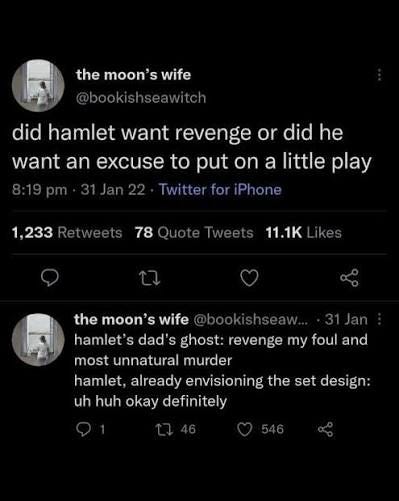
At least it does end up having some plot relevancy, as Hamlet develops his idea to test out the ghost’s story - and Claudius’ conscience. The play’s the thing. He does spend a far amount of time beating himself up for not being focused enough like the actors are on their scripts (?) (Is this another dig, Will?)
I didn’t realise, but to be or not to be is only just around the corner. I’d assumed it featured later on in the play but to be fair, Shakespeare put the pedal to the metal in act one, scene five, and hasn’t really let up the intensity since.